
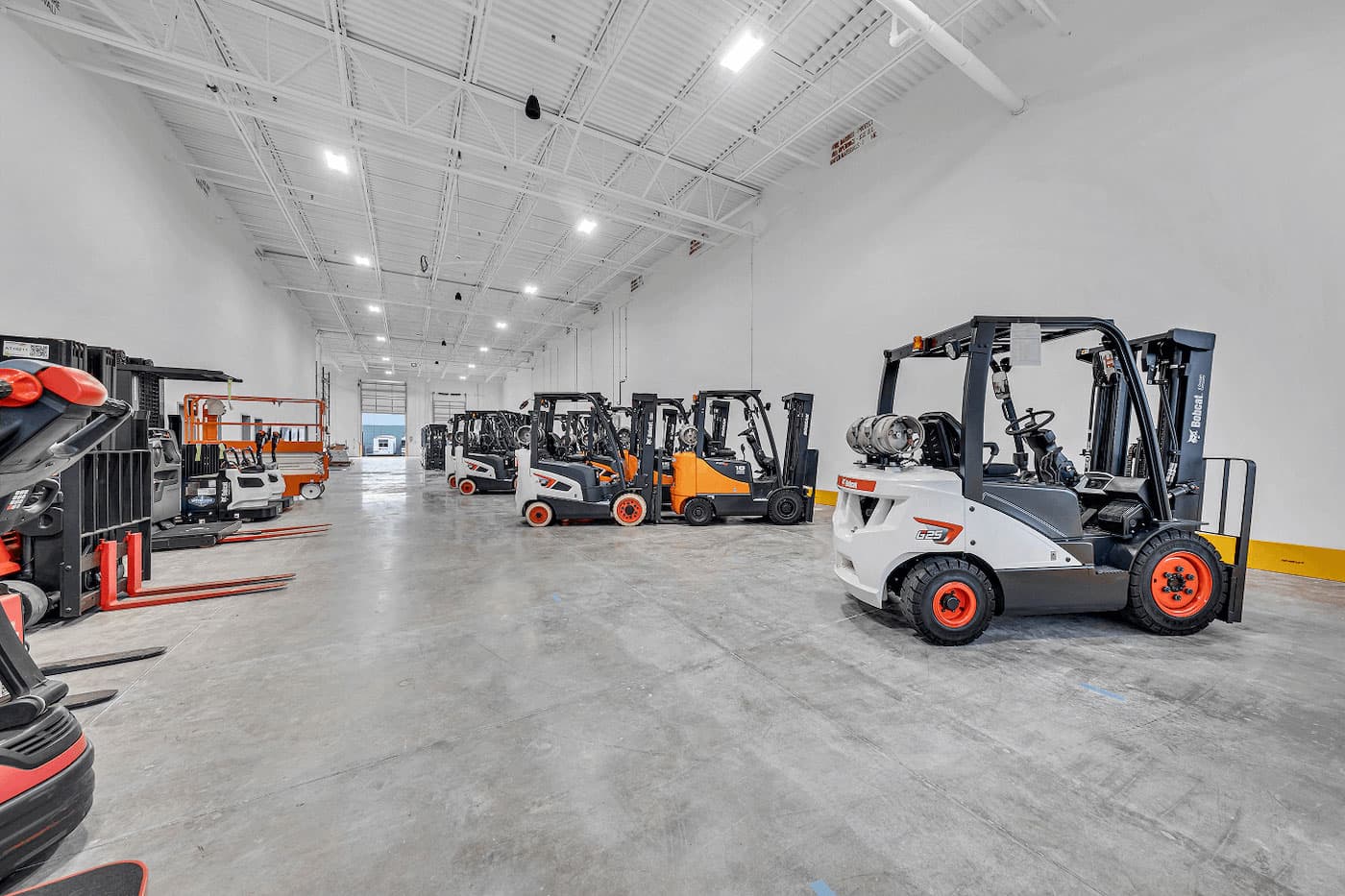
When I worked with Andersen Material Handling, the company had the kind of challenge I see often in industrial businesses: the operation itself was substantial, but the marketing did not yet reflect the depth of what the company could do.
Andersen was much more than a forklift dealer. The company sold and serviced forklifts, managed fleets, supplied warehouse products, provided consulting, and worked with integrated systems including robotic and automated solutions.
The opportunity was not simply to "do SEO."
It was to turn a traditional industrial marketing presence into something that could help the company attract customers, support its sales team, strengthen local visibility, and communicate a much broader value proposition.
First, Fix the Foundation
One of the biggest problems was technical.
Andersen was part of the Raymond dealer network, and a broader hosted web program had introduced duplicate content, iframe issues, and other technical problems that hurt both organic and local search performance.
Before trying to create more traffic, I needed to figure out what was holding the site back.
That started with a detailed audit and a page-by-page cleanup. Technical problems were corrected, content was improved, backlinks were developed, competitor link profiles were studied, social channels were cleaned up, and monthly reporting was put in place so the work could be adjusted as performance changed.
There is nothing particularly glamorous about fixing technical problems one page at a time.
But that is often where the real work begins.
Make Search Work Locally
Andersen operated across multiple markets, so ranking well in one city was not enough.
The local search strategy had to account for dealerships and territories across Michigan, northern Ohio, and South Florida.
For each location, we developed unique landing pages with local business information, relevant content, maps, internal links, and structured data. We also worked on citations and local profiles and created content around the industries and communities each dealership served.
The results were significant.
Traffic from Detroit, Ann Arbor, and Grand Rapids increased 100%. Toledo, Columbus, and Akron also showed substantial growth, and South Florida locations gained traffic through localized and Spanish-language content.
That matters because industrial search is often very geographic.
A company may sell nationally, regionally, or across several states, but the buyer still tends to search for the capability they need in the market they are in.
The Numbers Followed the Work
Over the course of the program, organic traffic increased by nearly 100%.
More than 20 primary branded and nonbranded keywords reached the first page of Google, while domain and page authority also improved.
Mobile traffic increased 106%, from 793 users in 2014 to 1,635 in 2015.
The broader traffic data also showed strong gains across Michigan, Ohio, Florida, Illinois, and New York, while organic visitor acquisition increased 98% year over year.
Those numbers are useful, but I would not consider them the whole case study.
The more important result was that Andersen had started building a stronger customer acquisition system around its website.
Search was bringing people in.
The site had clearer paths for different locations and customer needs.
Sales had better material to work with.
And the company was doing a better job of communicating the full scope of what it offered.
Support the Sales Team, Not Just the Website
Another major part of the engagement was sales collateral.
Andersen sold a wide range of products and services, and that created a familiar problem: too much information at once.
The sales team often found itself trying to explain everything the company could do in one conversation. The result was not always clarity.
Sometimes it was the industrial equivalent of handing someone a 14-page restaurant menu and asking them to decide in 30 seconds.
So we broke the story apart.
Instead of relying on one piece of collateral to explain everything, I developed more focused brochures around individual products, services, and customer problems. That gave salespeople and technicians something useful to pull out at the right moment instead of overwhelming the prospect with the entire catalog.
We also developed a broader corporate brochure to communicate something Andersen wanted customers to understand very clearly: they were more than a Raymond truck supplier. Their offering extended into warehouse products, automation, service, fleet management, and integrated systems.
That kind of work may look like "design" from the outside.
It is really sales strategy expressed visually.
The Website Eventually Had to Catch Up With the Business
By 2017, Andersen faced another major decision.
Raymond was offering its dealer network a more complex shared web platform. Andersen had the option of using that system or building a large standalone site that gave the company more control over its brand, content, search strategy, and user experience.
After evaluating the options, Andersen chose the independent route.
I worked on the overhaul as a co-producer, helping integrate the brand and sales strategy, designing the site, managing assets, developing search and messaging strategy, and coordinating with the development team.
The final WordPress site grew to more than 100 pages and included product catalogs, forms, maps, video, structured data, mobile-friendly design, and dealer-specific content.
Just as important, the messaging began to better reflect the company Andersen wanted to be.
The business wanted customers to see it as a partner rather than simply another equipment expense. We used customer and employee imagery to reinforce that relationship-focused positioning and developed content around the needs of four key buyer roles.
More Than an SEO Project
It would be easy to summarize this engagement as an SEO success.
That would sell the work short.
The real job was broader.
Andersen needed technical problems fixed. It needed better local visibility. It needed a stronger website. It needed better sales tools. It needed to communicate a larger product and service story. It needed different markets treated differently. And it needed the digital side of the business to support the people actually selling.
That is what made the work effective.
The organic traffic growth, first-page rankings, mobile gains, and stronger local visibility were the measurable outcomes.
The capability behind them was connecting strategy, search, design, content, sales support, and technology around the way an industrial company actually goes to market.
For manufacturers, distributors, equipment companies, contractors, and other B2B businesses, that distinction matters.
A website should not just describe the company.
It should help the company grow.
